Payment Reference ID: What It Is and How Gyms Track It | GymPilot | GymPilot
Payment Reference ID: What It Is and How Gyms Track It
Learn what a payment reference ID is, how it differs from UTR and transaction IDs, where to find it on UPI and card receipts, and how Indian gyms log it
GymPilot Team
13 min read
Looking for the product itself? See gym billing software — built for Indian gyms, with WhatsApp reminders and UPI tracking.
A payment reference ID is the unique number attached to one UPI or card payment. In India, a UPI reference number is commonly a 12-digit identifier, although some platforms and payment rails may display 12 or 15 digits.
A member may walk to the front desk with a WhatsApp screenshot and say, “The payment is done.” The screenshot may show the amount and a green success message, but the gym still needs the right number before marking the due as paid. That number connects the member's proof, the bank record, and the gym's collection entry.
The practical question is simple: which reference should staff write down, where can they find it, and what should they ask for when a payment is missing or disputed?
The Role of a Payment Reference ID
A payment reference ID is a system-generated identifier for one payment event. The bank, payment app, or gateway creates it after the member approves the payment. It identifies that transaction later. It does not describe the amount, the member's phone number, or a note typed by the sender.
A member paying ₹2,499 through UPI enters the amount, selects the gym's UPI address, and confirms the transfer. The app records the result and displays a reference number. The member does not choose it. A different payment made by another member receives a different identifier.
For the front desk, the reference works like a filing key. It ties three records to one payment:
The member's receipt, showing what the member believes was paid.
The bank debit, showing money leaving the member's account.
The gym's credit or gateway record, showing money reaching the merchant side.
That connection matters when a WhatsApp receipt, a Razorpay log, and a member's outstanding due need to be matched. Staff can write one searchable line in the daily collection sheet, then use the same reference to check the payment record.
The Reserve Bank of India includes transaction reference data alongside the timestamp and amount in its payment-system data-storage guidance. For an Indian gym, the reference therefore supports reconciliation, dispute handling, and record retention. The RBI payment-system data guidance explains the place of transaction reference data in regulated payment records.
Why the number matters at the desk
Names and notes can vary. “Rohit Kumar” may appear as “Rohit K.”, and two family members may share one phone number. A note such as “June fees” can also be entered incorrectly or copied into the wrong member's record.
The reference ID gives staff a more precise match. They can search it against the payment history instead of relying only on a name, screenshot, or message. Indian payment guidance describes the UPI reference number as an identifier used to trace and confirm a payment across banks. It commonly appears in app history, SMS alerts, and bank statements. The UPI transaction reference explainer notes the common 12-digit format and the possibility of 12 or 15 digits on different platforms.
Practical rule: A screenshot shows the result seen by the member. The reference ID helps the gym find and reconcile that payment in its own records.
Where the Reference ID Shows Up on a Payment
The fastest place to find a UPI reference number is usually the transaction detail screen inside the member's payment app. The member opens the payment history, selects the payment made to the gym, and expands the details. The front desk should ask for the detail screen, not only the first screenshot or the app home page.
In Google Pay, PhonePe, Paytm, and BHIM, the wording can differ. One app may call it a UPI transaction ID, another may show a bank reference number, and another may label it as a transaction reference. The useful item is the full identifier attached to that specific payment.
A member may also find the same payment reference in the bank SMS received after the debit. The bank statement can show the transaction date, amount, payee information, and a bank-side reference. For a clear explanation of how entries and identifiers are arranged on statements, the autobankstatement statement guide can help staff understand what to look for.
What staff should ask the member to open
A calm request avoids confusion:
Open the payment app used for the transfer.
Open Transaction history or Payments.
Select the payment made to the gym.
Tap Details, View details, or the equivalent option.
Read the complete UPI reference number exactly as displayed.
The front desk should record the amount, status, date, and reference together. A number without a matching amount can belong to a different payment.
The gym's WhatsApp confirmation is useful, but it's a second record, not the original payment reference. If the gym sends an automated receipt, the receipt should carry the same internal payment entry that staff created after checking the member's proof. This creates a clean line from the app to the member's message history.
Card receipts use different identifiers
A card charge slip may show a 12-digit card transaction reference, along with a separate authorisation code. That number doesn't have the same role as a UPI reference. A card payment processed through a gateway may also have a gateway payment ID and an order or invoice reference.
Staff should never assume that every 12-digit string is the UPI number. The payment method must be recorded first. If the member paid by card, the card receipt and gateway record should be checked. If the member paid by UPI, the UPI app detail screen is the correct starting point.
UPI Reference Number, UTR, Transaction ID, and Razorpay Payment ID Compared
These identifiers sit at different layers of the payment journey. Treating them as interchangeable creates avoidable delays, especially when a member's app shows one value and a Razorpay export shows another.
The UPI reference number is the transaction-level identifier commonly displayed by the UPI app. Industry explainers aligned with Indian banking usage describe it as a 12-digit identifier, while India-focused banking sources also note that some references may appear as 12 or 15 digits depending on the platform and rail. A UTR is generally the bank-level reference used to trace the transfer in bank records.
A Razorpay payment ID identifies the payment record inside Razorpay. It normally uses the gateway's payment format, such as a value beginning with pay_. Razorpay also distinguishes this payment ID from a merchant's reference_id. The payment ID belongs to the gateway record. The reference_id helps the merchant map gateway events or exports to an order, invoice, or member record. Razorpay's payment reconciliation documentation describes this separation.
Identifier
Where It Appears
Use For
UPI reference number
UPI app history, SMS, bank records
Matching the member's UPI payment to the gym collection
UTR or bank reference
Bank statement, bank support records
Tracing a bank-side debit, settlement, or dispute
Razorpay payment ID
Razorpay dashboard, gateway receipt, API response
Finding the specific gateway payment record
Razorpay reference_id
Merchant order, invoice, or reconciliation export
Linking the gateway event to the gym's internal record
Which one should the gym log
For a direct UPI collection, staff should log the full UPI reference number. If a bank statement or support team provides a UTR, it can be added as a separate bank-reference field, not substituted without explanation.
For a Razorpay card or UPI payment, staff should log the Razorpay payment ID in the gateway field and the member or invoice reference in the internal field. A gym that needs to retrieve a specific gateway record can use this guide to get Razorpay payment details.
The wrong identifier can still look convincing. A merchant reference may identify an invoice, but it may not help the bank locate a disputed debit. A UPI reference may help confirm the member's transfer, but it won't replace the gateway payment ID when support asks for the Razorpay record.
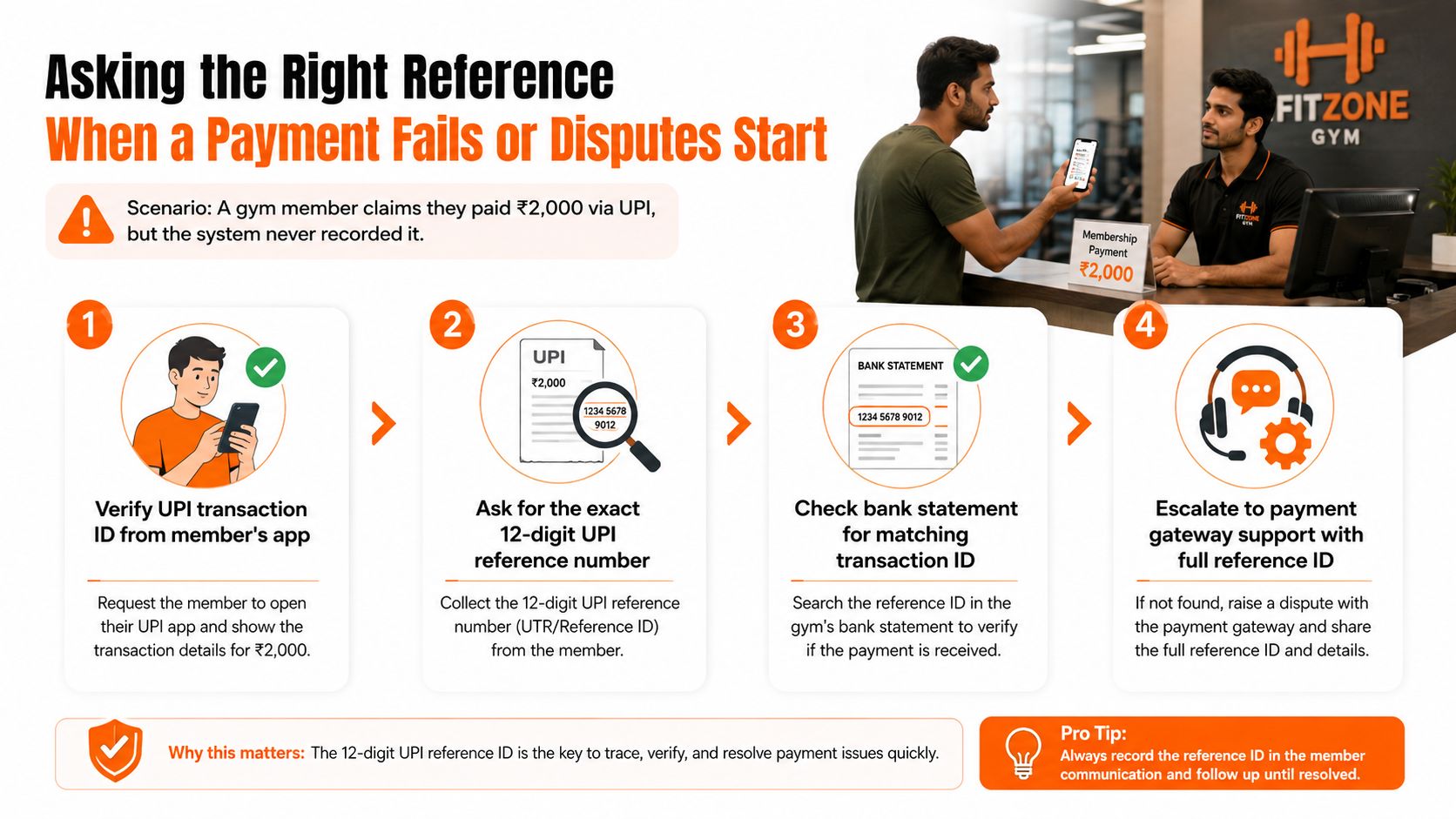
Asking the Right Reference When a Payment Fails or Disputes Start
A member named Arjun says he paid ₹2,000 through UPI, but the gym's payment entry is missing. The front desk shouldn't ask for “the transaction number” and accept the first string shown. It should work through the payment layers in order.
First, Arjun opens the UPI app and selects the payment. Staff ask for the full UPI reference number shown in the transaction details. They compare the payee, amount, date, and status. If the app says Failed or Pending, the gym shouldn't mark the membership due as settled merely because money appears to have left the account.
Follow the evidence in order
If Arjun's bank deducted the money, staff then ask for the UTR or bank reference shown in the bank SMS or statement. That value helps the bank or payment provider trace the debit at the bank level. The member's screenshot should show the actual status, not only a cropped image of the amount.
For a duplicate UPI payment, the member should provide both UTRs or bank references. Staff can then record both payment events and show that only one reached the gym's collection record. The duplicate case needs payment-provider or bank follow-up. A single reference cannot prove what happened to the second debit.
The process changes for an over-charged card payment. Staff ask the member for the Razorpay payment ID from the email receipt or gateway confirmation, then cross-check the last four digits of the card. The full card number must never be requested or stored.
The PM CARES UPI receipt flow also shows how a UPI payment can be searched using the payer's mobile number and the bank reference number or RRN received by SMS or email. That provides a useful model for asking for searchable proof rather than accepting an unclear screenshot.
For cash, there's no electronic reference. The record is the counter receipt number, the staff signature or initials, and the cash entry in the daily collection log.
A Front-Desk Logging Checklist for UPI, Cash, and Card Payments
A new front-desk hire should be able to log a payment without guessing. The entry needs enough detail for another staff member or the owner to find the original proof later.
UPI entries
Confirm that the member name in the gym record matches the payment context. Then copy the complete UPI reference number into the transaction or note field. Staff should also record the app used, such as Google Pay, PhonePe, Paytm, or BHIM, and check that the status says Success.
If the status is Pending or Failed, the entry should be flagged for review. A pending payment can't be treated as settled just because the member has shared a screenshot.
Card entries through Razorpay
Card payments need separate fields. The front desk should record:
Gateway ID: The Razorpay payment ID.
Card clue: The last four card digits shown on the receipt.
Billing match: The invoice or order number.
Keeping these values separate makes a later search easier. It also prevents staff from placing several unrelated identifiers in one long note.
Cash and partial payments
For cash, assign the next sequential receipt number. Write the staff initials, record the exact amount, and attach a photo of the counter receipt to the member's profile. The receipt number becomes the search key when there's no bank-generated reference.
A member may pay a membership in instalments. Each instalment should be a separate row with its own amount, date, method, and reference. A blended note such as “paid partly by UPI and cash” hides the collection trail and makes the remaining due harder to verify.
Resources on automating payment processing can help operators think about how payment records fit into wider workflows. The gym still needs a clear human check at the desk, especially when payment status or method is unclear. More India-specific guidance is available in this UPI payment tracking guide for gyms.
What staff should leave out
Never paste a full card number into a member profile. Never store a CVV. Never mark a payment as complete without a verifiable reference, receipt number, or other payment proof that another person can check.
From Receipt to Audit, Why Standardized Reference IDs Pay Off
The value appears during the daily close. If every UPI row carries its full reference number, every Razorpay row carries its payment ID, and every cash row carries a receipt number, the owner can match collections instead of reconstructing them from memory.
The owner can pull a Razorpay payout report, filter it by date, and compare each line with the front-desk entries. A missing payment reference points to a follow-up task. A duplicate reference points to a possible duplicate entry. A cash receipt without the expected counter record needs a separate check.
The same key should travel through the record
The member's WhatsApp receipt should identify the payment entry used by the gym. The member history should contain the method, amount, and reference. The revenue dashboard should draw from that same saved transaction, not from a separate spreadsheet updated later.
That connection helps in three practical situations:
Revenue review: The owner can investigate a dashboard gap by opening the matching payment row and checking its source reference.
WhatsApp disputes: Staff can reply with the recorded reference and payment status instead of searching through screenshots.
Tax and accounting questions: A transaction can be traced back to a receipt, gateway record, or bank entry. GST or TDS treatment still needs to be handled accurately with the gym's accountant, but the underlying payment trail is easier to retrieve.
A structured payment reconciliation software guide can help owners compare the workflow requirements before choosing a system. GymPilot is one option that records UPI, cash, and card payments, keeps member payment history, supports WhatsApp receipts and reminders, and provides revenue and staff activity views.
For broader business controls, an explanation of an audit trail for investor readiness shows why source records and activity history matter beyond payment collection. A small gym may not be preparing for investors, but the operating principle is the same.
Owner's test: If a payment row can't lead back to a member proof, bank or gateway record, or numbered cash receipt, the daily close isn't complete.
Consistent logging also protects the front desk from uncertainty. Staff can show exactly what was entered and when. Owners can review exceptions without treating every mismatch as misconduct. Over time, the gym gains a dependable record for renewals, dues, receipts, and collections.
Gym owners can start today by choosing one format for UPI references, Razorpay payment IDs, and cash receipt numbers, then requiring every front-desk entry to use it. For a digital workflow that combines member records, payment tracking, WhatsApp receipts, revenue visibility, attendance, and staff roles, review GymPilot's pricing and available options and set up the payment fields before the next busy collection period.
 GymPilot Team