Gym Management System Report Guide for Indian Gyms
A practical gym management system report guide for Indian gym owners. Covers KPIs, report templates, WhatsApp renewals, and how to act on every report.
 GymPilot Team
17 min read
A practical gym management system report guide for Indian gym owners. Covers KPIs, report templates, WhatsApp renewals, and how to act on every report.
GymPilot TeamAt 8:45 pm, the front desk is still busy. A member asks for a discount on renewal. A trainer accepts a cash payment and says it will be entered later. Someone forwards a UPI screenshot on WhatsApp. The owner wants to know this month's collections, but the answer sits across a notebook, a QR app, and several chat messages.
That's not a reporting system. It's a memory test.
A useful gym management system report turns those daily events into figures an owner can scan quickly, question, and act on. It shows money collected, payments still pending, members nearing expiry, attendance changes, and staff actions. For Indian gyms, reporting must follow the way money and communication work, with UPI, cash, cards, partial payments, WhatsApp, and GST-ready records at the centre.
A gym owner can run a small centre from a spreadsheet for a while. The problem starts when several people collect money, members pay in different modes, and renewals depend on reminders sent from personal phones. The owner may know that cash came in, but not whether every payment was recorded against the correct member, plan, and invoice.
Reporting becomes a cash-discipline tool, not a decorative dashboard.
The member asking for a discount creates a pricing and approval question. A staff activity log should show who changed the plan, what the old amount was, what the new amount became, and when the change happened.
The trainer taking cash creates a collection risk. A daily collection report should show the payment mode, member, plan, amount, and receipt status. The owner can then compare the cash recorded in the system with the cash physically held at closing.
The WhatsApp screenshot creates a reconciliation problem. A payment tracking report should connect the UPI, cash, or card entry to a member record and receipt trail. Indian gym billing guidance commonly treats cash, UPI, card, and bank transfer as practical payment modes, so the report must not assume that every member pays through a recurring card subscription. The GST billing guidance for Indian gyms also identifies payment mode as a useful invoice field.
The owner's uncertainty about monthly collections needs a monthly revenue summary. It should separate new memberships, renewals, personal training, product sales, refunds, adjustments, and outstanding dues.
Practical rule: If a report doesn't lead to a reconciliation, a follow-up, or an approval decision, it probably isn't an operating report.
India's fitness market is expanding from a low base. Deloitte and HFA estimate 12.3 million fitness facility members in 2024, with penetration at 0.8%, and project about 23.3 million members by 2030, an 11% CAGR. They also estimate the market at roughly ₹16,200 crore in CY24, projected to reach ₹37,700 crore by CY30, at around 15% CAGR in the same Deloitte and HFA market update. More members and more transactions make informal controls harder to maintain.
The rest of the operating model is simple. Revenue reports control collections. Renewal reports protect future income. Attendance reports reveal members who are drifting away. Staff logs show what happened when the owner wasn't at the desk.
Most owner decisions fall into four reporting families. They cover roughly 90 percent of the decisions an Indian gym owner makes in a month, from checking today's cash to deciding which members need a call.
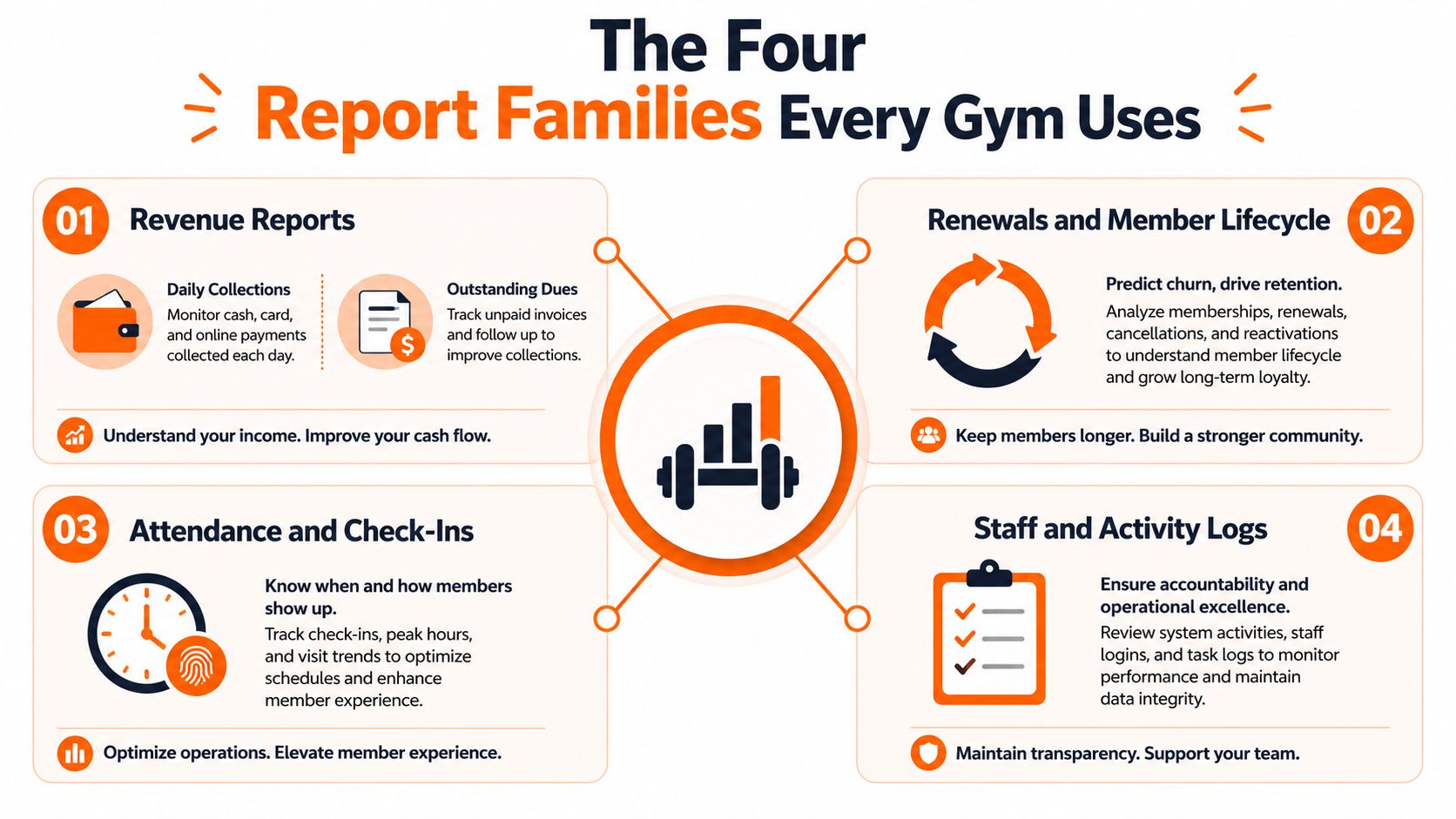
These answer one question: how much money came in, from where, and what remains unpaid? The owner needs payment mode, category, amount, invoice, staff user, and transaction date. A useful report separates UPI, cash, card, cheque, and bank transfer rather than presenting one total.
It also separates new sales, renewals, personal training, and product sales. That distinction matters because a busy month can still hide weak membership renewals if the total includes one-off purchases.
These answer: who is leaving, when, and what should happen this week? The report starts with join date, plan, expiry date, reminder history, response status, and renewal outcome.
A basic expiry count isn't enough. The owner needs to see members who were reminded, members who responded, members who paid, and members whose plans expired without a recorded response. WhatsApp workflows are commonly configured around T-7, T-3, and T-1 reminders, followed by a payment confirmation, as described in this India-focused WhatsApp automation playbook for gyms.
These answer: which paying members are using the gym? The report should show check-in source, time, visit count, last visit, and days since last visit. Biometric check-in, QR code, manual entry, and app check-in should remain distinguishable because each source carries a different level of control.
These answer: what happened at the desk and on the floor when the owner wasn't there? The record should identify the staff user, action, affected member, previous value, new value, payment mode, amount, and timestamp.
Owners comparing reporting interfaces can also use the Social Intents reports dashboard overview as a reference for how dashboards organise filters, summaries, and detailed records. The key test remains operational: can staff enter data quickly, and can the owner trace a questionable transaction without opening several files?
Revenue reporting should begin with the transaction, not the month-end total. A total can look healthy while cash entries are missing, UPI payments sit unmatched, or old dues remain untouched.
The report should include:
The first number to check is the cash column against the physical cash at closing. An Indian club using several UPI QR codes may discover that renewals are being paid through Google Pay instead of the cash collection pattern staff report verbally. The report doesn't need to guess why. It needs to show the payment mode clearly enough for the owner to ask the right question.
This report groups collections by category. It should show membership sales, renewals, personal training, product sales, refunds, adjustments, and total revenue. The first number to check is the renewal share of total revenue, because renewals indicate whether existing members are continuing.
This report lists the member, plan, invoice, original amount, amount paid, balance, due date, and age of the balance. The first number to check is the 30-plus-day bucket. Old dues require a named person and a scheduled follow-up, not another general reminder.
This report records refunds, discounts, freezes, plan changes, and manual corrections. It should show the original amount, revised amount, reason, approving user, and timestamp. The first number to check is the total value of adjustments, followed by every entry without an owner approval note.
| Report | Key Columns | First Number to Check | Owner Action Trigger |
|---|---|---|---|
| Daily Collection Report | Date, mode, member, plan, invoice, category, amount | Cash recorded versus cash held | Reconcile before the desk closes |
| Monthly Revenue Summary | Category totals, renewals, new sales, PT, products | Renewal share of revenue | Review weak renewal flow |
| Outstanding Dues Report | Member, balance, due date, ageing bucket | 30-plus-day balance | Assign a named collection follow-up |
| Refunds and Adjustments Report | Original amount, revised amount, reason, approver | Total adjustments | Review discounts, refunds, and edits |
A gym owner building this process can use the revenue tracking software guide to define the fields before choosing a system. The report should make every collection searchable, including partial payments and dues.
A renewal report begins with three raw inputs: member join date, plan expiry date, and the timestamped communication record. The communication record should identify whether the system sent a WhatsApp message, SMS, or call task, and whether the member responded.
A practical report includes:
The outcome field should distinguish renewed, lapsed, follow-up pending, upgraded, and downgraded. Without these outcomes, the owner sees only a list of expiry dates, not a renewal funnel.
A Delhi member on a one-month plan expires on 10 March. The system sends a T-7 WhatsApp reminder on 3 March. The member pays through UPI on 7 March, and the system marks the plan renewed. The report should connect all three events. It should also identify a member whose plan expired without a response or payment, so staff can follow up instead of assuming the member chose not to continue.
The owner should read the report from reminder sent to payment captured:
This shows which expiry windows produce action and which ones leak future revenue. It also shows whether a reminder was sent at all. A missed reminder is a process failure, while a delivered reminder with no response is a member follow-up issue.
| Member | Plan | Expiry Date | Days Left | Reminder Sent (Channel) | Reminder Date | Response | Renewal Status | Amount (INR) |
|---|---|---|---|---|---|---|---|---|
| Arjun Mehta | Monthly | 10 March | 7 | 3 March | UPI payment | Renewed | ₹2,000 | |
| Neha Sharma | Monthly | 10 March | 7 | 3 March | No response | Follow-up pending | ₹2,000 | |
| Rohan Das | Quarterly | 15 March | 12 | 8 March | Asked for call | Follow-up pending | ₹5,500 |
The gym membership renewal strategies for India can help owners turn these fields into a repeatable follow-up process. The essential point is ownership. A report without a staff user assigned to pending members is only a list.
Attendance data becomes useful when it flags renewal risk before the expiry date arrives. A member may remain active in billing records while visits fall sharply. That gap is a potential revenue leak, so owners should connect attendance changes to a specific follow-up action.
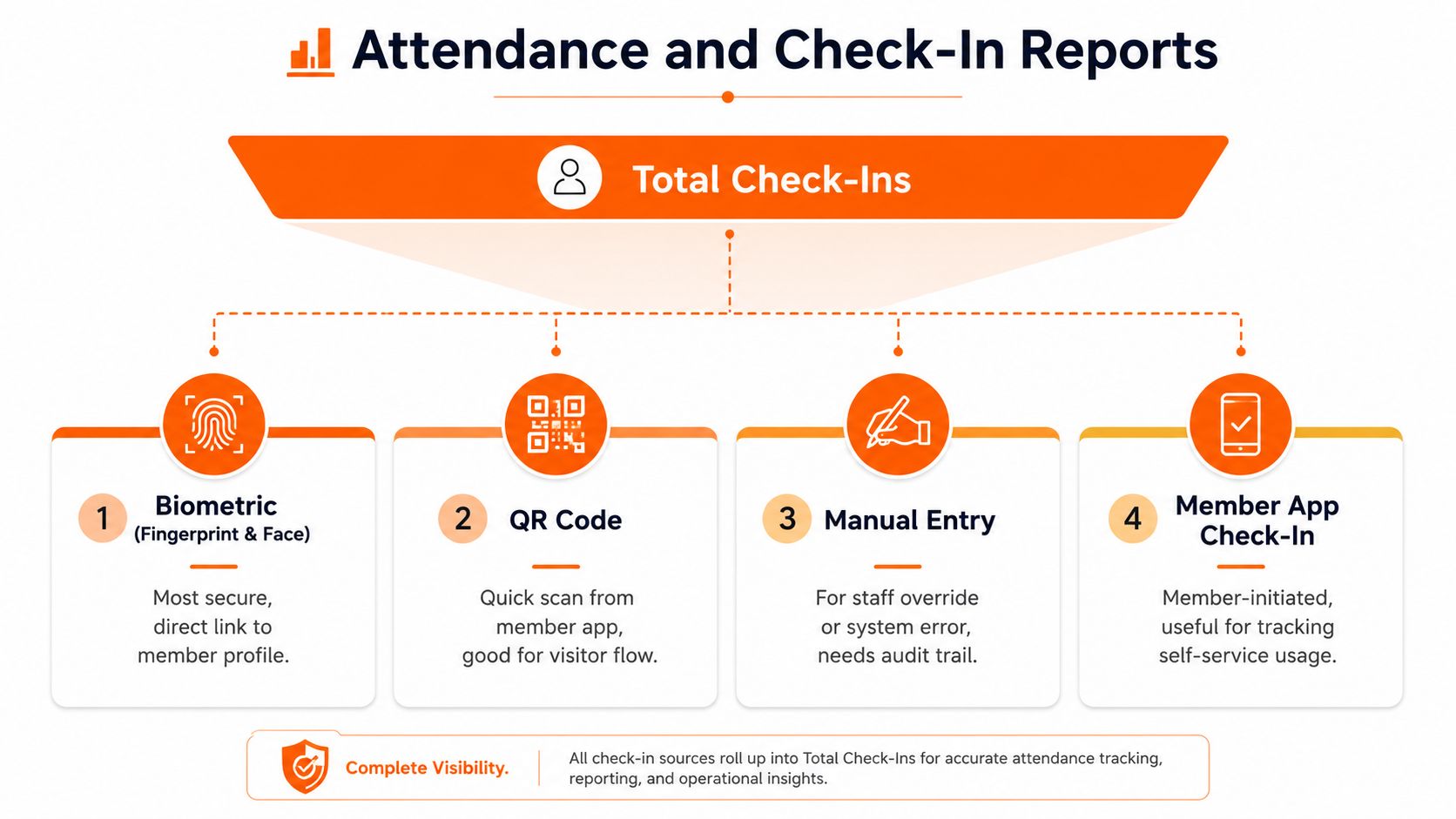
The report should show the date, member ID, check-in time, check-out time, source, and current-month visit count. Add average weekly visits, last visit date, and days since the last visit. These fields help the owner separate a genuine drop in usage from a recording problem.
The source needs its own column:
A Bangalore member joined on 1 January and averaged 9 visits a month for two months. In March, attendance fell to 2 visits. If the plan expires later that month, the system should flag the change for the renewal team. Staff can contact the member before sending a routine expiry message.
The owner should also review the attendance source. A high number of manual entries may indicate weak front-desk controls or inaccurate reporting. Indian gym owners can use this gym attendance tracking software guide for India to assess the fields and workflow their reporting module should support.
For attendance follow-up, use the low-visit filter and apply the renewal workflow covered earlier. Assign each flagged member to a trainer or front-desk user, record the outcome, and compare the result with later renewals. The report earns its place when it helps recover a member before inactivity becomes lost revenue.
The staff and activity log is the gym's transaction ledger. Every material action should be timestamped and tied to a user, so the owner can see who changed what without relying on verbal explanations.
The useful columns include:
A front-desk employee in Pune applies a 50% discount without owner approval at 9:42 pm on a cash payment of ₹4,500. The activity log should surface the original amount, discounted amount, staff account, member, payment mode, and timestamp. The owner can then ask whether the discount was authorised and whether the cash received matches the recorded amount.
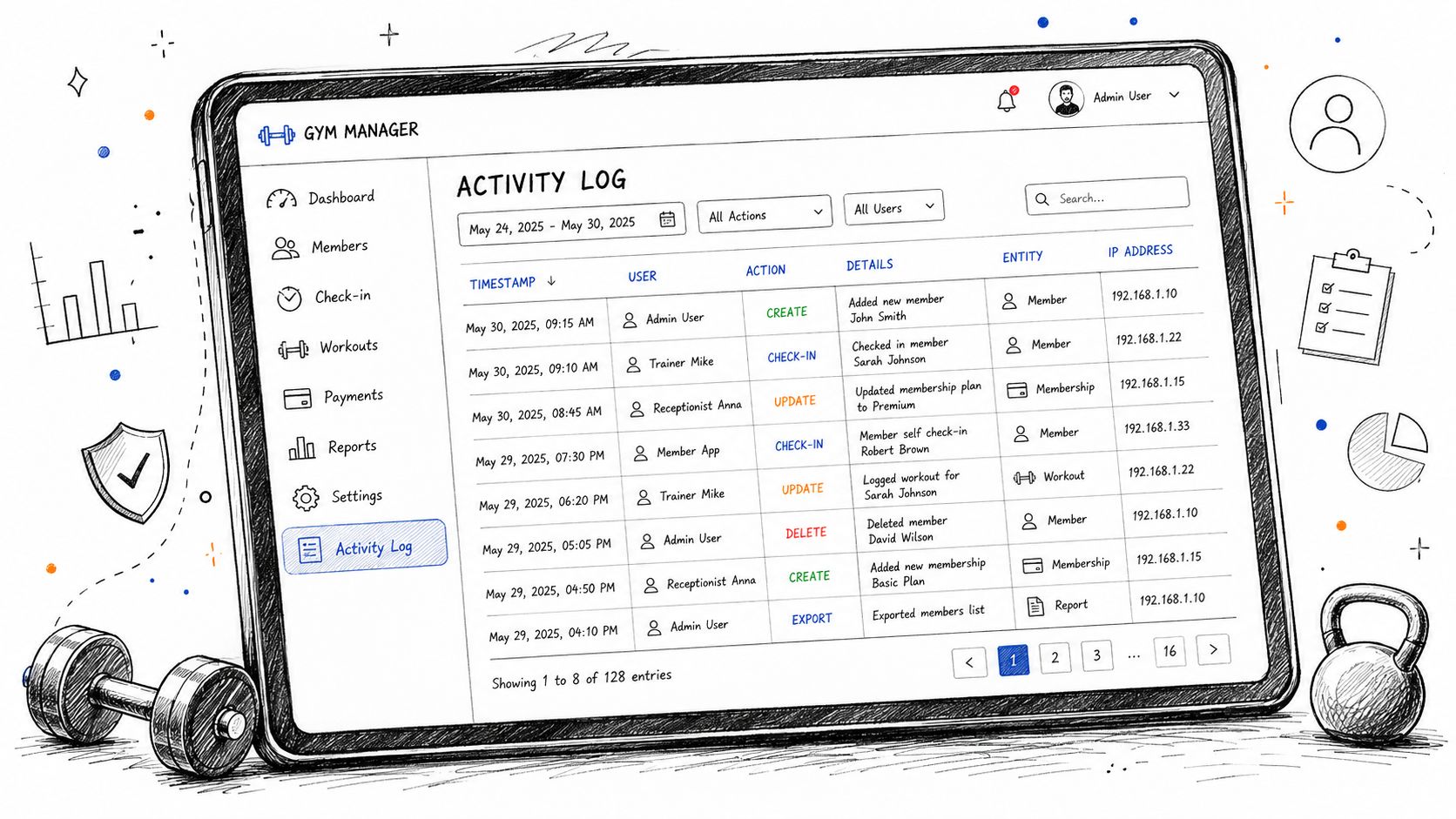
An immutable log matters because staff shouldn't be able to rewrite the history after a discrepancy appears. Owner WhatsApp alerts add speed. A new member, renewal, payment, discount, or refund can prompt an immediate review instead of waiting for month-end reconciliation.
Role-based access matters too. Front-desk staff should record members and payments, while sensitive settings and report access remain restricted to approved roles. The rule is simple: any payment or plan edit must be visible to the owner within minutes, not at month end.
The right format depends on where the owner works. A single-gym owner who spends the day on the floor needs short summaries on a phone. A manager overseeing a larger membership base needs drill-down data. An accountant needs records that can be saved and compared.
| Format | Best For | Report Families Covered | Main Limitation |
|---|---|---|---|
| Daily WhatsApp summary | Owner rarely at a desk | Revenue, renewals, staff alerts | Limited detail and filtering |
| Live dashboard | Manager or owner reviewing trends | All four families | Requires regular screen-based review |
| Weekly CSV or PDF export | GST, audits, and branch comparison | Revenue, renewals, activity logs | Not real-time |
A daily WhatsApp summary should arrive at closing and include cash collected, UPI collected, card collected, pending dues, renewals, and unusual staff actions. It suits a single centre where the owner needs control without opening a laptop.
A live dashboard suits a gym with a manager reviewing member-level records, plan performance, attendance patterns, and staff activity. It should let the manager move from a total to the underlying transaction.
A weekly CSV or PDF export fits owners who keep offline records for GST filings, audits, or comparison across branches. Gym and fitness centre services are associated with SAC 999723 under India's GST classification, according to this guide to GST for gym and fitness businesses. The export should preserve invoice, payment mode, taxable service, and adjustment details.
Owners who want a broader explanation of how reporting formats support decisions can consult this modern data analysis guide. The format should follow the workflow, not the vendor's feature list.
A number has no operational value until a named person does something with it. The owner should set a deadline for every important report signal.
If the monthly collection rate falls below 85%, the owner should review pending payments and hold a walk-in session with the front desk within seven days. The owner owns the review. The front-desk manager supplies the member list and explains every unrecorded or disputed payment.
If more than 20% of members are in the last 14 days of their plan, the manager should start the WhatsApp reminder sequence with a one-week and three-day nudge. The manager owns the queue and checks that each reminder has a delivery status and an outcome.
Members below 4 visits in a month should enter a re-engagement list. The trainer owns the follow-up call within the week and records whether the member is travelling, injured, dissatisfied, or inactive.
A late shift opening, missed cash entry, unexpected refund, or unapproved discount triggers a manager audit. The manager checks the timestamp, user, member record, payment mode, and supporting explanation before closing the issue.
The same logic applies to payment reconciliation. India's digital payment infrastructure supports this workflow at scale. The government reported that UPI handled 24,162 crore transactions in FY2025-26, worth ₹314 lakh crore, with daily average transactions reaching 66 crore. Monthly volume crossed 2,300 crore in May 2026 and reached 2,366 crore in July 2026, as reported in this Press Information Bureau update on UPI. A gym still needs to record cash and card payments, but UPI transactions can be tied to searchable receipts and reconciliation records.
A 30 to 300 member gym doesn't need a separate reporting department. It needs fixed ownership and fixed review times.
Monday morning: The owner opens the weekly CSV or PDF export and checks collected revenue against the gym's target. Any difference goes to the manager with a member-level list.
Tuesday: The manager reviews upcoming expiries and schedules WhatsApp reminders for the next two weeks. Members marked follow-up pending receive an assigned staff owner.
Wednesday: The trainer reviews low-attendance members and makes re-engagement calls. The trainer records the outcome so the renewal report contains more than a status such as “not renewed”.
Every evening: The owner receives a WhatsApp summary showing cash, UPI, card, pending amounts, renewals, refunds, and notable staff actions. The front desk reconciles cash before closing.
Friday: The owner reviews the activity log for discounts, refunds, plan freezes, attendance edits, and missed cash entries. The manager closes or escalates every irregular item.
This routine works because each report has a fixed time, owner, and output. It can support one branch or help an operator compare two gyms without turning every review into a fresh investigation.
Before choosing a gym management system report module, an owner should check whether it can answer these questions:
GymPilot is one Indian-focused option that provides member records, WhatsApp welcome messages, receipts and expiry reminders, payment tracking for UPI, cash, card, partial payments and dues, revenue reporting, attendance and check-in tools, product sales, staff roles, email notifications, and biometric check-in. Owners should still test the actual workflows with their front-desk team before adopting any system.
A missing field is not a minor software gap. It becomes a reconciliation gap, a missed renewal, or an unexplained adjustment.
A gym owner should start with one week of real transactions, not a sales demo. Record every cash, UPI, card, partial payment, renewal, discount, and check-in. Then compare the system's reports with the desk register and bank or UPI records. To review whether GymPilot fits that workflow, visit the GymPilot pricing page and test the reporting fields with the people who will use them every day.