At 8:30 in the evening, the front desk is handling three things at once. One member wants to renew by UPI, another has brought cash, and a third is asking why the expiry reminder never arrived. The owner is deciding whether the current full-gym model still makes sense or whether a smaller, specialised fitness studio would be easier to run.
This gym x fitness studio decision isn't about copying the latest format. It affects rent, equipment, staffing, payment control, member expectations, and the owner's ability to forecast renewals. India's paid fitness-services market was estimated at about ₹16,200 crore in 2024 and is projected to reach ₹37,700 crore by 2030, with roughly 15% annual growth over that period, according to the India fitness market outlook. The opportunity is real, but the workable model depends on the operator's location, capital, expertise, and daily discipline.
The Everyday Dilemma Facing Indian Gym Owners
At 8:30 in the evening, the front desk may be checking a UPI payment, counting cash, and answering a WhatsApp renewal query at the same time. The owner sees a busy floor, yet may not know which memberships expire soon, which dues remain open, or whether each cash receipt was entered correctly.
This gap is operational, not cosmetic. A staff member may send a reminder only after noticing an expiry in a paper register. Another may record a UPI payment but forget to update the membership status. During a crowded shift, even a spreadsheet becomes difficult to verify. Front-desk accountability depends on a clear record of payments, renewals, and follow-ups, not on memory.
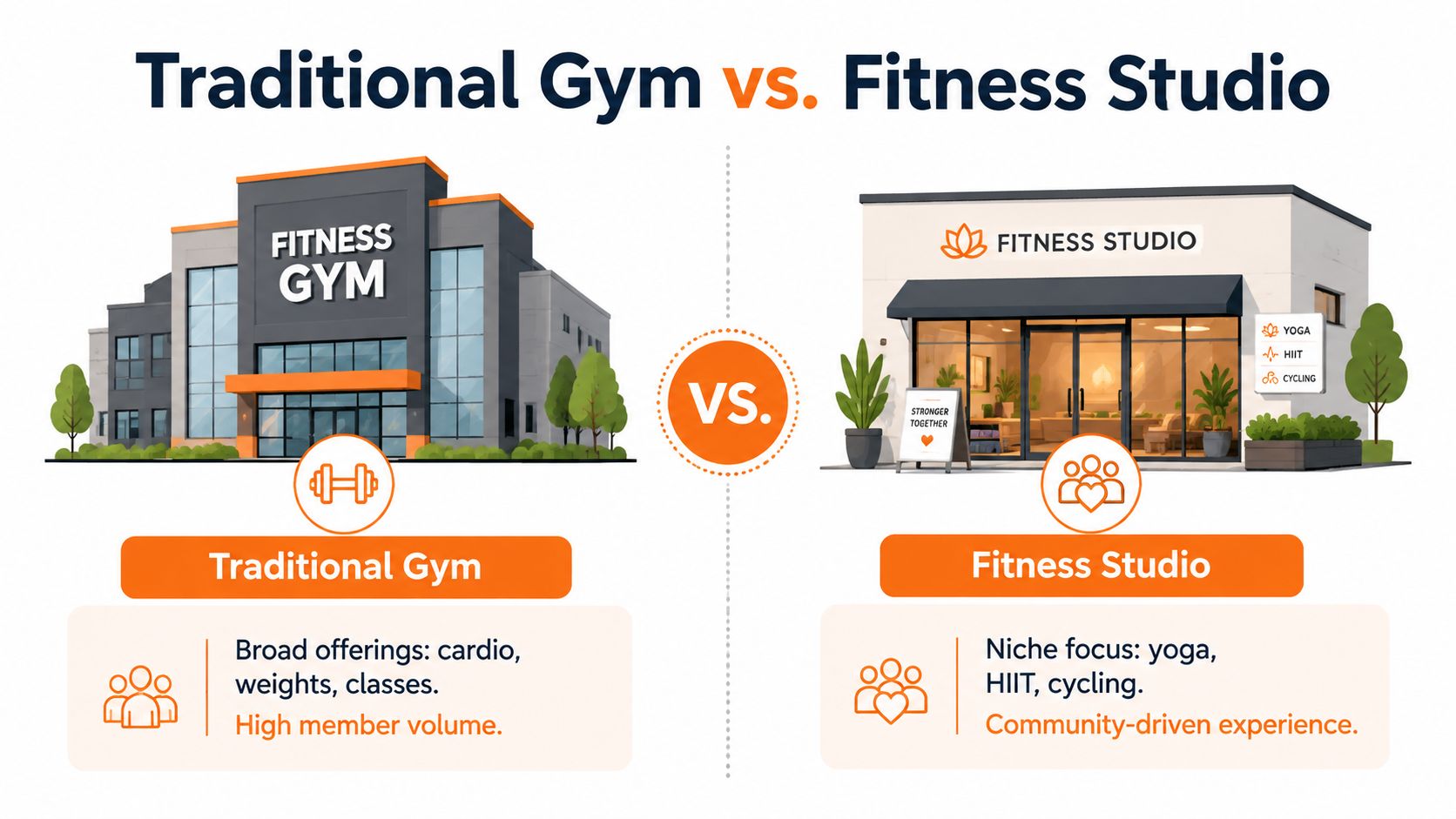
The gym x fitness studio choice changes this workload. A traditional gym serves varied goals through broad access, so daily control centres on check-ins, equipment use, enquiries, and many individual renewals. A studio narrows the offer to activities such as yoga, cycling, HIIT, Pilates, or functional training. Its pressure shifts towards class capacity, instructor attendance, scheduled sessions, and consistent member communication.
Neither model removes payment discipline. In India, UPI can make collections quick while leaving reconciliation incomplete if staff do not match each transaction to the right member. Cash creates a different risk, because the owner needs a reliable handover and end-of-day count. WhatsApp is useful for reminders, but messages sent informally can leave no dependable renewal trail.
A growing market with low penetration
India had about 46,500 fitness facilities and around 12.3 million members in 2024, with membership penetration at 0.8% of the population, according to the India fitness market study. Membership is projected to reach 23.3 million by 2030, while penetration moves above 1.7%.
That opportunity does not compensate for weak controls. A gym can gain members while losing revenue through missed renewals, unreconciled cash, and unrecorded UPI payments. A studio can build strong attendance while becoming dependent on one instructor or one person managing member records.
Practical rule: Choose the model whose daily pressure your team can control consistently, not the one that looks most attractive on social media.
Overview of the Two Models
A traditional gym is built around breadth. It may combine cardio equipment, free weights, resistance machines, open training areas, and group sessions. Members pay for access and flexibility. They can arrive at different times, train independently, and use different zones according to their goals.
A boutique fitness studio is built around depth. It usually concentrates on one or two activities and sells a guided experience. Members may attend scheduled sessions led by a familiar instructor, follow a structured programme, and value the community as much as the physical training.
The basic operating distinction
Area
Traditional Gym
Boutique Fitness Studio
Core offer
Equipment access and broad training options
Instructor-led sessions and a defined modality
Member relationship
Often centred on access, convenience, and value
Often centred on coaching, identity, and community
Revenue logic
More members using a larger facility
Fewer members paying for a specialised experience
Daily pressure
Check-ins, enquiries, equipment upkeep, and payment volume
Class attendance, instructor availability, and session consistency
Main risk
Empty capacity and missed renewals
Dependence on instructors and scheduled demand
Best operational focus
Member records, expiry visibility, dues, and staff accountability
Session organisation, instructor coordination, attendance, and communication
A broad gym can appeal to beginners, weight trainers, cardio users, and members who want open access. That flexibility supports volume, but it also creates a less personal member journey unless staff actively follow up.
A studio has a clearer identity. Its marketing can focus on a particular outcome or training style, but the business becomes more sensitive to instructor quality, class timing, and attendance patterns. A cancelled or poorly covered session affects the member experience immediately.
The choice also changes the payment conversation. Gym members commonly renew access through UPI or cash. Studio members may pay for a defined programme, class package, or period of guided sessions. Both models need accurate records, but the owner is watching different risks.
Business Model Differences That Shape Your Bottom Line
The traditional gym carries a larger fixed-cost structure. Rent, equipment finance, utilities, maintenance, and front-desk coverage continue even when attendance is weak. The owner therefore needs enough active members and steady renewals to keep the facility productive throughout the month.
A studio generally uses less space and fewer categories of equipment. That can make the cost base easier to control, but the studio depends more heavily on scheduled sessions. Empty class spots, instructor absences, and weak timetable decisions can reduce revenue even when the premises remain open.
Volume compared with experience
A gym usually sells access at scale. Its offer may be attractive to members who want freedom, a wide equipment selection, and a monthly fee that feels practical. The challenge is that many members can attend less frequently after joining, which makes timely follow-up important.
A studio sells structured participation. Its member may be more closely connected to the instructor and the class group. That connection can support renewals, but it also creates concentration risk. If the lead instructor leaves, changes availability, or loses member trust, the owner may need to rebuild the experience quickly.
The first 90 days deserve close attention. Commentary focused on Indian gym retention says this period accounts for about 60% of member drop-offs, while gyms using automated reminders report 25% to 40% lower churn, according to the gym retention calculator and retention guidance. These figures should be treated as context from that source, not as a promise for every facility.
Predictability comes from process
Neither model produces predictable revenue automatically. A gym needs a visible expiry list, clear dues records, and a consistent renewal process. A studio needs reliable attendance records, a stable timetable, and a way to identify members who are drifting away from sessions.
A useful operating distinction looks like this:
Traditional gym: The owner manages capacity, access, equipment use, renewals, and mixed payment collection.
Boutique studio: The owner manages class capacity, instructor delivery, attendance, programme continuity, and member commitment.
Both models: The front desk must issue receipts, record every payment, and escalate overdue or expiring accounts.
The gym's risk is often spread across many members and many daily transactions. The studio's risk can be concentrated in a smaller member base and a smaller instructor group. The right model depends on whether the owner prefers managing volume and facility overhead or managing experience and delivery consistency.
Space, Equipment, and What Members Actually Expect
Space sends a direct signal about the business. A traditional gym needs room for multiple training zones, while a studio can use a smaller footprint to create a focused environment. The decision should begin with the local property, rent, access, parking, ventilation, and the type of member likely to travel there.
A broad facility may suit a location with mixed demand and enough room for equipment variety. A boutique studio can work where members value a particular format and don't need an open gym. However, a smaller floor plan doesn't remove the need for careful layout. Crowded mats, poor circulation, or insufficient storage can damage the experience quickly.
Space and Equipment Comparison
Factor
Traditional Gym
Boutique Fitness Studio
Typical layout
Separate cardio, strength, free-weight, and activity areas
Open training floor designed around one core format
Equipment approach
Multiple equipment categories for varied goals
Specialised equipment chosen for the selected modality
Member expectation
Flexible access and independent training
Structured sessions and instructor guidance
Space pressure
Equipment spacing, queues, cleaning, and maintenance
Session capacity, movement flow, storage, and class reset
Staff requirement
Floor support and reception coverage
Instructor presence and class coordination
Investment question
Whether equipment variety supports member acquisition
Whether specialised equipment supports the programme and pricing
Match equipment to the promise
A gym that advertises broad access needs enough usable equipment to support different training styles. A studio that sells yoga, cycling, Pilates, HIIT, or functional training shouldn't purchase equipment that doesn't improve that specific experience.
Owners considering external finance should examine cash flow, repayment obligations, maintenance, and utilisation before seeking qualifying for equipment financing. Equipment is useful only when members use it and the business can carry its cost during slower periods.
The cardio training equipment guide can also help operators think through equipment selection by use case rather than by appearance. A treadmill or bike occupies space, consumes maintenance attention, and creates expectations about availability.
The member sees the floor first
Members don't evaluate a space only by its size. They notice whether the equipment works, whether staff keep the area organised, whether sessions start on time, and whether the environment fits the promise made during the sales conversation.
A traditional gym should protect open access without allowing peak-hour congestion to become normal. A studio should protect class quality without creating a timetable that depends on one person being available every day. In both cases, layout decisions should support the operating model rather than imitate a larger or more fashionable facility.
Pricing Structures and Payment Flows in India
Indian gym pricing works differently from the recurring-card model common in some Western markets. Members often pay through UPI, cash, or card, and the front desk may process monthly fees, advance periods, partial payments, and outstanding dues in the same shift.
UPI accounted for 88.9% of payment transaction volume in India in December 2025, while representing 9.0% of transaction value. Its average ticket size was about ₹1,293, according to the RBI payment systems analysis. That combination makes UPI well suited to frequent membership collections and renewals, but it also means the operator must reconcile many individual transactions accurately.
Pricing the offer, not just the floor
A traditional gym generally competes through access, equipment range, convenience, and perceived value. Its pricing may include monthly, quarterly, half-yearly, or annual options, but every option creates a different expiry date and collection schedule.
A studio can price around a guided format, a programme, or a defined package. The member isn't only paying to enter a facility. The payment supports instructor time, session structure, coaching, and a consistent experience.
The operational challenge appears when a member pays only part of the amount. The system should show the original charge, the amount received, the remaining dues, the payment method, and the receipt history. A front-desk note saying “balance pending” isn't enough if another staff member needs to understand the account later.
GST and invoice discipline
Gym and fitness services are classified under SAC 999723. A current India-focused GST guide states that the rate changed from 18% to 5% from 22 September 2025, with the 5% treatment applying without input tax credit, as described in this GST guide for gym membership services. A separate GST guide for physical wellness and fitness services describes the earlier 18% treatment and the same SAC classification.
Tax treatment should be confirmed with the gym's accountant, especially where the business has changed its invoicing process. The front desk still has a clear responsibility. It must record collections consistently, identify the payment channel, and issue a receipt that matches the transaction.
For owners comparing billing tools, the gym fees structure guide provides a practical reference for separating plans, dues, and payment timing. A team evaluating its own internal software budget can also review pricing for teams, but the decision should rest on workflow fit rather than the displayed price alone.
Cash-control rule: Every payment should have one recorded amount, one payment method, one member account, and one accountable staff action.
Staffing, Operations, and Marketing Approaches
A traditional gym usually needs reception coverage across longer opening hours. Staff handle check-ins, enquiries, plan explanations, payment entries, receipts, member questions, and sometimes equipment-related requests.
A studio may operate with a leaner front desk, but the instructor carries more responsibility for the member experience. Class quality, punctuality, attendance, substitutions, and personal follow-up can determine whether the member continues.
Different work, same accountability
A gym's manager may need to review who accepted cash, who adjusted a due amount, and who marked a member as active. A studio manager may need to check attendance, instructor coverage, and whether members received schedule updates.
The public discussion around Indian gym operations often focuses on apps and digital check-ins, but the front desk still has to control the complete transaction trail. A UPI screenshot, a cash note, or a card slip shouldn't sit outside the member record.
Marketing also changes with the model:
Traditional gym marketing: Emphasises access, equipment variety, location, flexible timings, and practical value.
Studio marketing: Emphasises the modality, instructor credibility, class experience, and community.
Retention communication: Uses clear welcome messages, receipts, and expiry notices instead of relying on staff memory.
Local visibility: Connects offers to the neighbourhood, nearby offices, residential communities, and member referrals.
That makes WhatsApp a practical channel for welcome messages, payment receipts, and expiry reminders. Email can still support formal communication, but a front desk shouldn't assume members check it with the same regularity as WhatsApp.
A social media calendar can help a small team organise promotional posts and instructor content. Owners comparing options may find a best scheduling tool for small teams useful for planning that activity. It won't replace payment controls or member records. Marketing organisation and financial accountability are separate jobs.
Which Model Suits Your Goals and How Software Supports Both
An Indian gym owner may have strong demand but still lose track of collections when the reception desk handles UPI, cash, card payments, and WhatsApp requests throughout the day. A studio owner may run fewer sessions yet face equal pressure to fill classes, protect instructor quality, and renew members on time. The right model depends on which operation the owner can deliver consistently.
If the business has...
The stronger fit may be...
Larger usable space and varied local demand
Traditional gym
A recognised instructor or specialised method
Boutique studio
Capital tied up in equipment and facility costs
Traditional gym, if member volume supports it
A preference for scheduled sessions and community building
Boutique studio
Many daily payments and long reception hours
A system focused on records, dues, and staff activity
A small team that needs consistent member communication
A system focused on automation and visibility
Match software to daily risk
A traditional gym needs quick access to membership status, plan dates, payment history, attendance, check-ins, and outstanding dues. A studio needs those financial controls too, with closer tracking of class attendance, instructor delivery, and member follow-up.
Test any platform against the actual front-desk routine:
Can staff record UPI, cash, card, partial payments, and dues?
Can the owner view collections without waiting for a spreadsheet?
Can members receive a receipt immediately after payment?
Can the system send welcome and expiry messages through WhatsApp?
Can staff use restricted roles instead of unrestricted access?
Can the owner review activity logs and check-in records?
Can the business record product sales alongside memberships?
These controls matter because a payment marked in a WhatsApp chat is not the same as a payment reconciled in the member record. Cash collections need the same visibility. Staff should be able to collect money quickly, while the owner can verify who received it, which plan it covered, and whether any balance remains.
GymPilot is one option for Indian fitness businesses. It includes member management, attendance and check-in, payment tracking across UPI, cash, and card, digital receipts, a revenue dashboard, product sales, staff roles, email notifications, and biometric check-in. Its WhatsApp automation covers welcome messages, payment receipts, and expiry reminders. Owner alerts and activity logs help review staff actions.
Owner visibility matters more than feature volume. A modest system that records every collection and expiry clearly is more useful than a complex system staff avoid using.
Review the member list this week. Mark each active membership by expiry date, payment method, and outstanding due. Then ask the front-desk team where UPI, cash, receipts, and WhatsApp reminders currently fail. Choose the model and software combination that keeps collections accurate, member records current, and renewals independent of staff memory.
 GymPilot Team