Is Gym Business Profitable in India: Real Numbers
Is gym business profitable in India? We break down real ARPU, fixed costs, break-even math, and collection gaps that decide if your gym actually makes money.
 GymPilot Team
18 min read
Is gym business profitable in India? We break down real ARPU, fixed costs, break-even math, and collection gaps that decide if your gym actually makes money.
GymPilot TeamMost advice on whether a gym business is profitable in India starts with market size, rising fitness awareness, and a confident revenue projection. That's the wrong starting point for an independent owner. A gym can have a busy floor, a long member list, and attractive billed revenue, yet still struggle to pay rent because billed revenue isn't the same as collected revenue.
Money reaches Indian gyms through UPI, cash, cards, and bank transfers. Renewals happen late, expired members continue training, and front-desk records often sit across notebooks, spreadsheets, QR screenshots, and personal messages. The practical question isn't only whether India has enough demand. It's whether a gym can collect, reconcile, and retain the money it bills.
The popular pitch says India's fitness market is booming, so opening a gym should be a straightforward opportunity. The broader market was estimated at about ₹16,200 crore in 2024, across roughly 46,500 fitness centres and 12.3 million members, and it's projected to reach ₹37,700 crore by 2030, according to Ken Research's India fitness market analysis. That is meaningful demand, but it doesn't describe the economics of one gym in one neighbourhood.
Aggregate market value includes different formats, locations, price points, and operators. It doesn't tell an owner whether the reception desk records every UPI payment, whether cash reaches the bank, or whether members renew after their plans expire. Market size measures total activity. It doesn't guarantee unit-level profit.

Paid fitness-facility membership penetration was about 0.8% of India's population in 2024 and is projected to reach around 1.7% by 2030. Membership is projected to rise from 12.3 million to approximately 23.2 to 23.3 million over that period, as reported in the Health and Fitness Association India fitness market report. The opportunity remains underdeveloped, particularly in urban and semi-urban areas.
But a growing addressable market won't rescue poor collections. A member listed as active may have an expired plan, pending dues, or a payment that was promised but not received. That member adds to the owner's apparent footfall while adding nothing reliable to the bank balance.
Practical rule: Count paying members separately from enrolled members. The second number is useful for sales. The first number pays the bills.
Value gyms still account for 56% of market revenue, 78% of memberships, and 80% of facilities, according to the figures cited by MyGymDesk's gym ROI calculator. This mix explains why many operators can't depend on high membership prices alone. They need strong utilisation, renewals, personal training, and product sales.
The owner who asks, “How many people have joined?” should also ask:
That operating discipline determines whether the market opportunity becomes profit or merely keeps the gym busy.
A poster price rarely matches monthly earnings because annual discounts, corporate rates, and instalments reduce the amount collected per member. Personal training can raise revenue from engaged members, but it requires trainer capacity, follow-up, and a separate purchase decision.
A 2026 India gym-industry report estimates average revenue per active member at about ₹1,100 per month overall, including approximately ₹780 in value gyms, ₹1,830 in boutique studios, and ₹2,310 in premium clubs, as detailed by Manage Your Gym's India gym-industry statistics. The same report estimates annual turnover of about ₹24 lakh from around 258 members for an average value gym, compared with about ₹1.1 crore from around 407 members for a premium club.
These figures give owners a useful positioning reference. A premium club can operate with fewer members, provided its service and collections support the higher fee. A value gym depends more heavily on floor density, renewals, attendance, and tight payment follow-up.
| Gym Segment | Monthly Billed ARPU (₹) | Net Collected ARPU (₹) | PT Add-on Uptake | Typical Annual Discount |
|---|---|---|---|---|
| Value gym | ₹780 | Track from actual receipts | Limited and uneven | Varies by operator |
| Boutique studio | ₹1,830 | Track after discounts and dues | More common among engaged members | Varies by operator |
| Premium club | ₹2,310 | Track after discounts and dues | Often central to the offer | Varies by operator |
The segment averages are reference points, not promises. They do not establish a universal personal-training uptake rate or discount level. Calculate net collected ARPU from receipts and reconciled bank records, rather than relying on the fee printed on a membership form.
UPI and cash require different controls. UPI receipts should match the member ledger and settlement report. Cash needs a counted handover, receipt number, and daily deposit record. Late renewals and front-desk concessions can widen the gap between billed revenue and money retained by the business.
Track three values separately:
Personal training may substantially increase one member's value, but adding it across the full membership forecast will overstate revenue. Forecast PT income only against active clients, available trainer hours, and confirmed collections.
For pricing context, operators can review this guide to gym membership fees when assessing plan structures and fee communication. Compare the advertised rate with the amount that reliably reaches the business account.
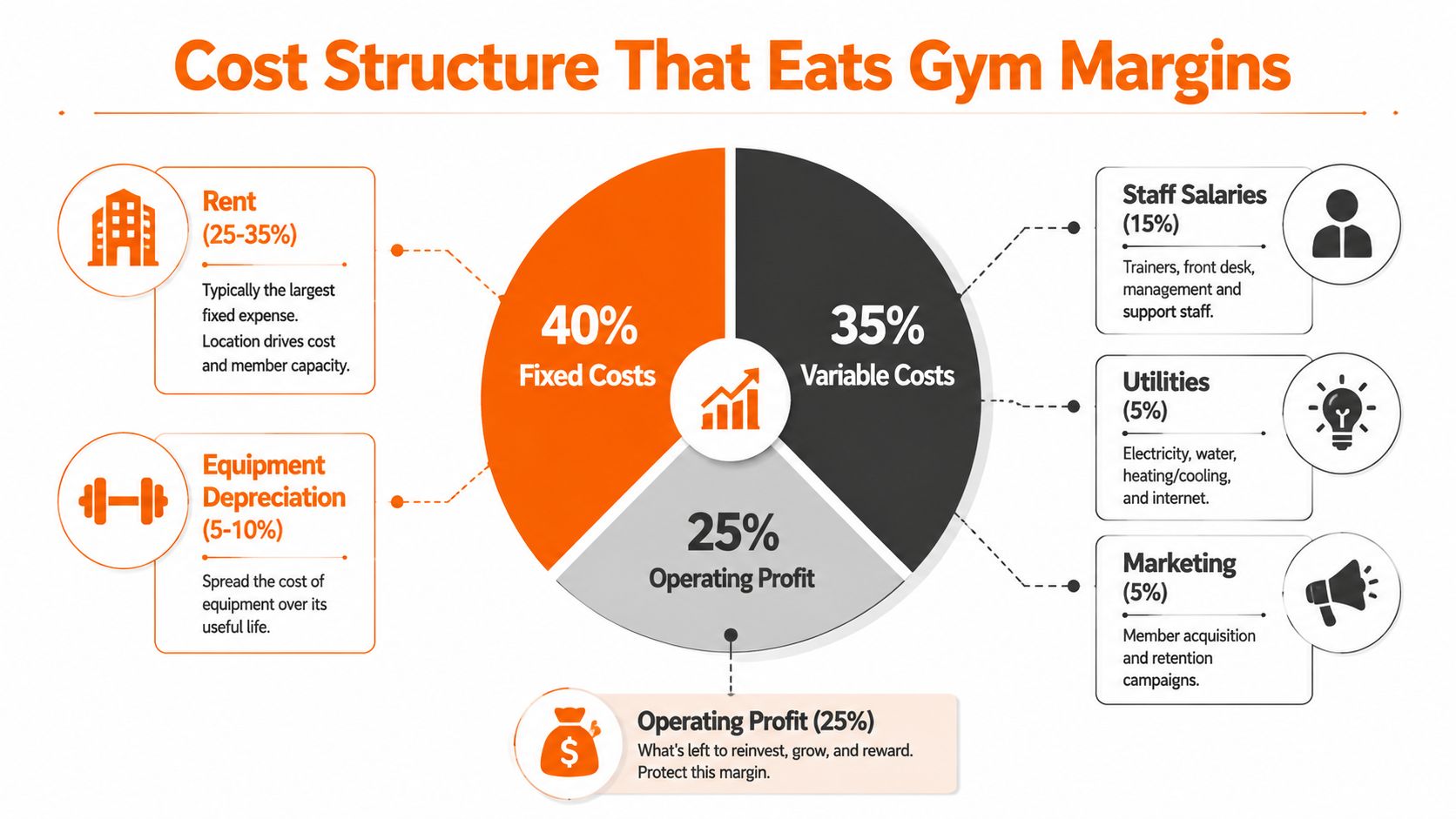
Gym costs become dangerous when the owner commits to them before collections become dependable. Rent, salaries, equipment finance, and power bills don't wait for a slow renewal month. The business carries them whether the floor is full or quiet.
A mid-sized gym usually has a fixed base made up of rent, equipment obligations, core staff, software, insurance, and basic administration. Variable expenses include electricity usage, cleaning materials, repairs, freelance trainer payouts, product inventory, and local marketing. Each category needs its own owner and review rhythm.
Rent is often the largest location-linked commitment. Equipment may be purchased outright, financed, or treated as an asset that needs replacement and maintenance. Staff costs cover front desk, floor supervision, housekeeping, and management, but cutting the wrong role can damage collections and member service.
Electricity deserves close attention in AC-heavy facilities. Air conditioning, lighting, showers, music systems, and equipment all contribute to the monthly bill. Maintenance also arrives irregularly, which makes it easy to under-budget until a treadmill, compressor, or cable machine fails.
For equipment financing decisions, an owner can review this Capital Express gym equipment guide to compare the operational implications of buying and financing. The important question is not whether equipment looks impressive. It's whether the expected member density can support the repayment or depreciation burden.
Gym and fitness-centre services are commonly treated as taxable under GST at 18%, with SAC 999723 cited for physical well-being services, including gymnasium and fitness-centre access, as explained in this gym GST compliance guide. A bill of ₹10,000 before tax becomes ₹11,800 after GST at that rate.
That extra collection isn't operating profit. The front desk must record the tax-inclusive amount correctly, reconcile the payment, and preserve the taxable base for accounting. A gym that treats the full receipt as spendable revenue can create a cash-flow problem when tax obligations fall due.
Rent and salaries are difficult to reduce quickly. This makes collected member revenue the critical lever. Owners should review expenses against cash received, not against membership promises or attendance totals.
What changes the break-even answer is how many members pay during the month, not how many names sit in the database. Consider a metro-suburb gym with 150 members and a stated average ARPU of ₹2,000 per month. The model uses these monthly cost assumptions:
| Cost Head | Monthly Amount (₹) | Notes |
|---|---|---|
| Rent | ₹80,000 | Fixed occupancy cost |
| Staff salaries | ₹1,20,000 | Three trainers plus front desk |
| Electricity and AC | ₹35,000 | Operating utility assumption |
| Miscellaneous | ₹15,000 | General operating expenses |
| Equipment maintenance and cleaning | ₹20,000 | Variable operating costs |
| Total monthly cost | ₹2,70,000 | Fixed and variable costs combined |
At ₹2,000 collected per paying member, calculate:
Break-even members = total monthly cost ÷ collected revenue per member
That gives ₹2,70,000 ÷ ₹2,000 = 135 paying members. The gym therefore needs 135 active members whose fees are valid and collected during that month to cover the listed costs.
The front desk must separate billed revenue from money received. UPI and cash collections, delayed renewals, informal discounts, and missed receipt entries can leave the ledger showing more revenue than the bank account and cashbook contain.
Assume 20% of enrolled members have expired plans or pending dues. The gym then needs more than 135 names on its roster to produce 135 paying members. Approximately 170 enrolled members would be required under that assumption, because only the paying portion supports break-even.
That figure is a working model, not a forecast for every gym. A facility with 150 enrolled members can remain below break-even when renewals are late, dues are unresolved, or front-desk collections are not reconciled daily.
Use the open gym cost guide to organise setup and operating assumptions, then replace generic inputs with local rent, actual payroll, utility bills, maintenance history, and collected receipts. Track billed memberships, cash received, UPI settlements, and outstanding dues in separate columns. That makes the monthly shortfall visible before it becomes a payroll or rent problem.
The break-even point moves every month. It rises when costs increase, discounts deepen, or dues remain unpaid. It falls when valid renewals and collected ARPU improve.
The same gym format can produce different results in Mumbai or Bengaluru compared with Indore or Coimbatore. Tier-1 locations may support stronger pricing because of income levels, office catchments, premium apartments, and demand for specialised services. They also bring heavier rent, more competitors, and higher expectations around interiors, equipment, and staffing.
Tier-2 locations often offer a thinner cost base. The owner may pay less for space and staff, while referrals and local relationships can reduce dependence on paid advertising. The trade-off is a lower ceiling for premium pricing and add-on services.
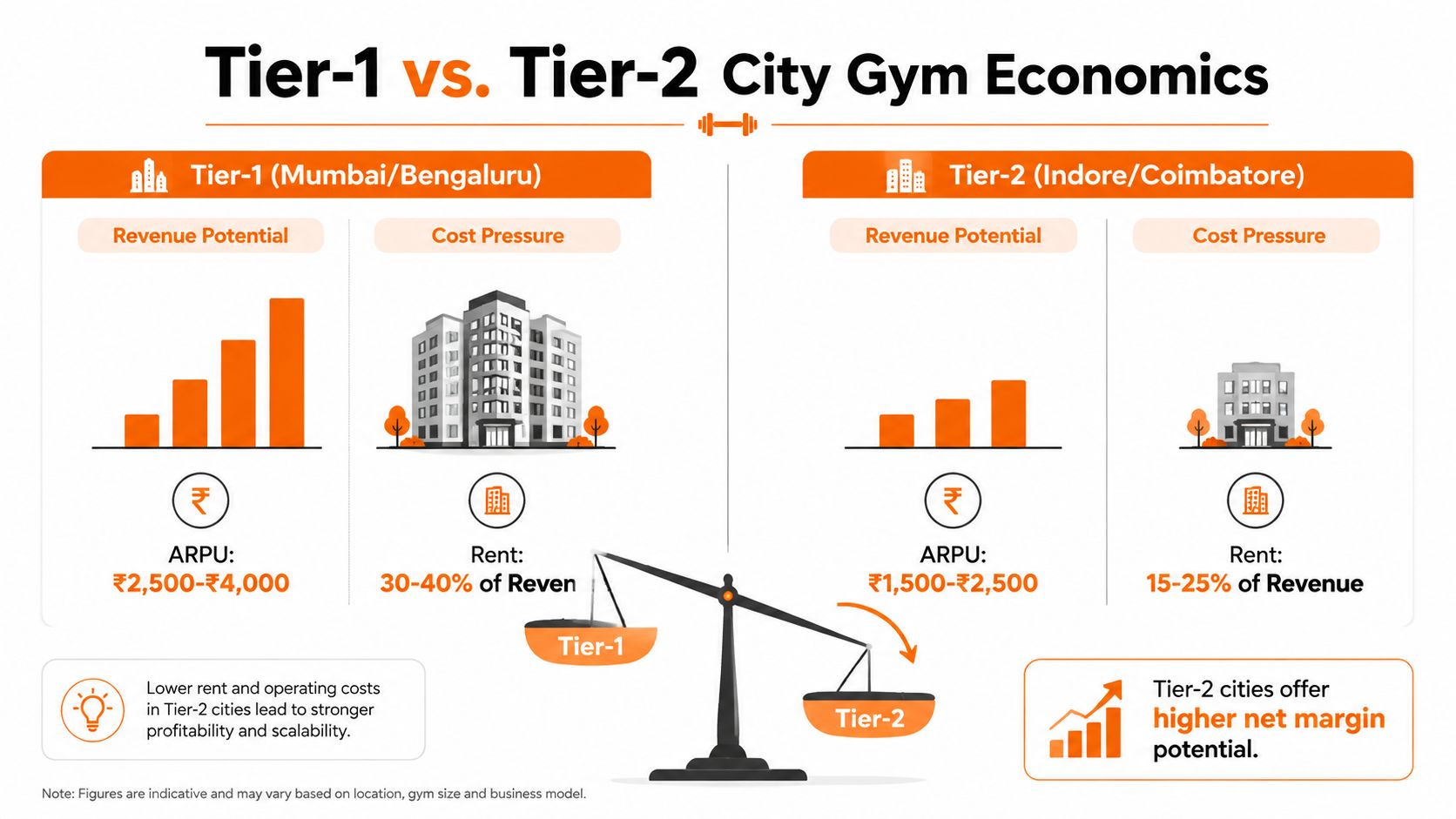
In a Tier-1 city, a gym may be able to charge more when it serves a strong residential or corporate catchment. But premium pricing doesn't automatically compensate for rent. Chains and established brands can also push owners towards annual-plan discounts, especially when several gyms compete within convenient travelling distance.
The owner must map:
A high-rent location needs enough paying density to justify the space. A full floor at discounted prices can still produce weaker profit than a smaller, disciplined operation.
A Tier-2 gym may reach break-even with fewer paying members because rent and staffing commitments are lower. Word-of-mouth can support acquisition, and the owner may have more flexibility to build a local community instead of matching every chain promotion.
The limitation comes later. The local market may resist premium personal training, nutrition packages, or higher membership rates. Growth can therefore depend on improving retention, selling relevant add-ons, and using the available space efficiently.
There isn't a universal winner. Tier-1 offers more revenue potential and more cost pressure. Tier-2 offers a lower entry burden and potentially faster break-even, but a smaller premium ceiling. The correct choice depends on the exact property, catchment, rent agreement, and collection habits.
FitZone is a realistic example of how a gym can look healthy in a monthly review while cash flow remains weak. The Pune-suburb gym has 200 members, an advertised average ARPU of ₹2,000, and reported monthly revenue of ₹4,00,000. Against stated monthly costs of ₹2,80,000, the owner sees a neat paper profit of ₹1,20,000.
The floor is busy. Trainers recognise members by name. The active-member list looks impressive. The owner assumes the business is working because demand appears strong.
A closer reconciliation changes the picture.
FitZone finds that 35 members are using the gym after their quarterly plans expired. Another 15 members paid in cash, but the money was never deposited. A further 10 annual members cancelled during their plan cycle but remained on the active roster.
These are different failures, and each needs a different control. Expired usage is a renewal and access-control issue. Undeposited cash is a front-desk and reconciliation issue. Cancelled members remaining active is a data-quality and reporting issue.
The listed member count hides all three.
After the owner removes unsupported revenue and accounts for actual receipts, monthly collected revenue falls to ₹3,10,000. Against the same ₹2,80,000 cost base, the remaining margin is only ₹30,000. An unexpected AC compressor repair can absorb that amount and leave no practical operating surplus.
A busy gym can still be cash-poor when the roster records promises instead of payments.
The lesson isn't that FitZone lacks demand. It has demand. The problem is that staff and systems haven't converted every valid transaction into a recorded, deposited, reconciled receipt.
The owner should review four lists every day:
A floor manager may judge performance by attendance. The owner must judge performance by collected revenue, valid access, and traceable transactions.
Profit improvement often starts at the front desk, not with another advertising campaign. Indian gyms commonly receive payments through UPI and cash, so the process must make every transaction visible without adding unnecessary work for staff.
UPI is already a normal retail payment behaviour in India. NPCI reported that UPI crossed 16 billion monthly transactions and ₹23.49 lakh crore in monthly value in July 2026, as cited in this GST and gym membership payment guide. A gym should use that familiarity to make payment, receipt creation, and reconciliation part of one routine.
Send renewal reminders before expiry, again close to the due date, and immediately after expiry. WhatsApp is more practical than relying only on email for many members. DataReportal reported 536 million WhatsApp users in India in early 2025, according to the India digital usage reference.
The workflow should be simple:
A post-expiry follow-up should be prompt because members often delay with “next week” and then disappear into routine. Festival offers and family add-ons can support renewals, but discounts should be recorded clearly so the owner knows the realised price.
A Google Sheet can work for a single location if one person owns the update process. It must include member status, plan dates, payment method, amount received, amount due, and reconciliation status. For a structured workflow, payment reconciliation software for gyms can help organise these records.
GymPilot is one option. It records UPI, cash, and card payments, tracks dues, issues WhatsApp welcome messages and receipts, sends expiry reminders, and provides revenue, attendance, product-sales, and staff-management records. It also supports role-based staff access, activity logs, email notifications, and biometric check-in.
For products such as protein bars, the owner should calculate purchase cost, selling price, expiry risk, and wastage separately. This guide to protein bar margins offers useful context for reviewing that ancillary line.
A gym pro-forma must follow cash through the business. Separate what the sales desk billed from what members paid, deposited, and reconciled. Update the sheet monthly, then compare it with bank entries, UPI records, cash counts, and receipts. Verbal promises do not pay rent.
| Line Item | Amount (₹) | Notes |
|---|---|---|
| Value membership collections | Enter amount | Use actual receipts |
| Boutique or premium collections | Enter amount | Separate by plan type |
| Personal training collections | Enter amount | Record trainer payout separately |
| Product sales | Enter amount | Track cost of goods |
| Total billed revenue | Enter amount | Amount invoiced or promised |
| Collection rate | Enter percentage | Collected revenue divided by billed revenue |
| Total collected revenue | Enter amount | UPI, cash, card, and transfers |
| Rent | Enter amount | Include deposit-related obligations separately |
| Salaries | Enter amount | Front desk, trainers, housekeeping |
| Equipment EMI or depreciation | Enter amount | Use the chosen accounting treatment |
| Electricity and utilities | Enter amount | Review seasonal movement |
| Maintenance and cleaning | Enter amount | Include repairs and consumables |
| Marketing | Enter amount | Local and digital campaigns |
| GST and professional costs | Enter amount | Confirm treatment with the accountant |
| Operating surplus or deficit | Enter amount | Collected revenue minus costs |
The collection-rate line deserves daily attention, even if the formal sheet is updated monthly. A membership billed at the desk is not operating income until the payment is received and matched to the member's account. Record cash and UPI separately when a member uses both, then reconcile the combined amount against that membership.
A simple review can expose leakage quickly. Compare the day's sales register with UPI settlements, cash deposited, card settlements, and receipts issued. Investigate any gap while the transaction is still easy to trace.
For a 3,000-square-foot gym in a Tier-2 city, model the first 18 months as a ramp, not a straight line. Create columns from Month 1 to Month 18 and enter:
Break-even arrives when collected revenue covers total monthly costs. The timing can slip if launch pre-sales are discounted, annual-plan cash is spent too early, or renewals weaken from Month 4 onward. A pre-sale may fund opening work, yet it says little about recurring operating health.
The forecast should also show late renewals and unpaid dues by month. A member who remains active in the software but has not paid can make retention and revenue appear healthier than they are. Staff and systems may still fail to convert a valid transaction into a recorded, deposited, reconciled receipt.
India's paid fitness market is projected to reach ₹37,700 crore by 2030, but that projection does not remove local cost pressure or collection risk, as noted by Ken Research. Profit depends on daily operating discipline, including renewal follow-up, front-desk controls, trainer payouts, and protection of collected cash.
Use this decision framework:
So, is gym business profitable in India? Yes, when the owner manages collected revenue as tightly as membership growth. Renewals must arrive on time, UPI and cash must reconcile, staff actions must remain visible, and every rupee promised must be tested against money received.
Before signing a lease or buying equipment, build the monthly pro-forma, count paying members rather than names on the roster, and test each assumption against local rent and actual collection behaviour. Then review the GymPilot pricing page to assess whether a structured member, payment, attendance, and WhatsApp workflow fits the gym's operating needs.