Most advice about a gym membership app starts in the wrong place. It talks about branded member portals, recurring card billing, workout tracking, and polished mobile experiences. That model may suit a large international chain, but it doesn't match how most Indian gyms collect money or communicate with members.
A gym in India usually deals with UPI, cash, card payments, transfers, dues, and part-payments. Members are more likely to read a WhatsApp reminder than open another app. The practical question isn't whether a gym can offer a better-looking digital experience. It's whether the software helps the front desk identify expiring memberships, record every payment correctly, and follow up before a member disappears from the renewal list.
India's digital fitness market is already large enough to justify serious software investment. One estimate places the country's fitness app market at USD 521.06 million in 2025, with a projection of USD 2,912.10 million by 2034, an 18.69% CAGR from 2026 to 2034 (IMARC's India fitness app market estimate). A separate forecast estimates revenue of USD 601.6 million in 2025, rising to USD 1,847.9 million by 2033 (India fitness app market forecast).
The opportunity is real, but the buying decision must stay operational. The right system catches renewals, brings UPI and cash into one ledger, and gives the owner a reliable view of collections. A consumer app that members rarely open is an expensive distraction.
Why Most Indian Gyms Do Not Need an App at All
A polished member app sounds useful until the owner asks what members must do inside it. If the answer is mainly “check the profile” or “view the membership”, the app has solved a branding problem, not a revenue problem.
Indian gyms often collect monthly fees through UPI and cash, with card payments, bank transfers, and partial settlements appearing alongside them. A member may pay part of a fee today and clear the balance later. A front-desk employee may confirm a UPI payment from a screenshot, write a cash receipt in a register, and then update a spreadsheet at closing time. The risk sits in the gaps between those actions.
The same mismatch appears in communication. A member may ignore email, forget an app password, or never install the gym's branded application. WhatsApp fits the existing habit far better. India has roughly 535 to 550 million WhatsApp users, and India-focused business messaging reports cite about 98% open rates for WhatsApp, compared with much lower email open rates (India WhatsApp business messaging statistics).
The leak is usually administrative
The usual leak isn't a lack of workout content. It is a missed expiry date, an unrecorded cash payment, a member marked as paid without a matching receipt, or a follow-up that never happened.
A useful system should answer these questions quickly:
- Who expires soon?
- Who is overdue?
- Who has paid partly?
- Which payments arrived by UPI, cash, or card?
- Which staff member recorded each transaction?
- What has been collected today?
Practical rule: If the front desk still needs a notebook and a spreadsheet after buying the app, the gym bought presentation instead of control.
India's paid digital fitness audience is also substantial. A market report estimates 55.0 million paid active users in 2025, rising to about 137 million by 2032, while market value rises from USD 705 million to USD 2,141 million over the same period (India digital fitness and wellness platforms report). That supports investment in digital operations, but it doesn't prove that every gym needs a standalone consumer app.
For a single-location gym, the sensible starting point is a renewal and payment system with WhatsApp communication. Member-facing features should earn their place by improving collections, attendance, or service delivery. Otherwise, they add another login for staff and another installation request for members.
What a Gym Membership App Actually Does
A gym membership app is operational software. It keeps member records, stores plan details, tracks expiry dates, records payments, shows attendance, and helps staff follow up. It isn't primarily a fitness tracking tool, although some large brands may add workout plans, class bookings, nutrition content, or progress logs to their own member applications.
The distinction matters because a gym owner buys the software to run the business. The front desk needs a searchable member profile, the correct plan dates, a payment history, and a clear indication of what remains due. The owner needs collections, attendance, staff activity, and outstanding amounts without asking someone to prepare a spreadsheet.
The generic model versus the India-fit model
The generic Western model often assumes recurring card billing. A member enters card details, authorises an automatic charge, receives a digital notification, and manages the membership through a branded portal. That can reduce manual collection work when members use stable card subscriptions.
The India-fit model starts elsewhere. It assumes that payment may arrive through UPI, cash, card, or a part-payment. It expects staff to verify a transaction, assign it to the right member, issue a receipt, and preserve the remaining balance. It also assumes that a renewal reminder should arrive in a channel the member already checks.
A practical workflow looks like this:
- Create the member record with contact details, plan, start date, and expiry date.
- Record the payment and identify its method, whether UPI, cash, card, or partial payment.
- Track the balance so staff can see paid, pending, and overdue amounts.
- Send the reminder before expiry through WhatsApp or email.
- Confirm the collection with a receipt and an updated payment history.
- Review the business through revenue, attendance, product sales, and staff records.
The system should also handle freezes and extensions. Members travel, fall ill, or pause training. If the front desk changes dates in an informal register, the expiry list becomes unreliable.
A simple staff interface matters more than a long feature catalogue. For a gym with one location and a modest team, the receptionist must be able to complete the common workflow without learning an enterprise system. The software should make the correct action easier than the workaround.
Core Features That Matter in India
The essential features are the ones that match the front desk's actual day. A membership database without payment context is incomplete. Payment tracking without expiry reminders leaves collections dependent on memory. Attendance without a usable check-in method creates another manual task.
The first requirement is a member directory. Each profile should show the plan, start date, end date, expiry status, payment history, and relevant notes. Custom plan durations matter because Indian gyms sell monthly, quarterly, annual, promotional, and ad-hoc memberships. The system shouldn't force every member into a single billing pattern.
Payment records must reflect real collections
A useful payment layer records UPI, cash, card, and partial payments. It should show the amount received, the balance remaining, the date, the receipt, and the staff member who entered the transaction. This replaces the common practice of keeping UPI screenshots in one phone, cash notes in a register, and dues in a spreadsheet.
UPI is particularly important because it is a dominant payment rail in India. The government reported 24,161.69 crore UPI transactions worth ₹314.23 lakh crore in FY 2025-26, with 55.49 crore onboarded users by June 2026 (Government of India UPI figures). The exact workflow still requires verification. RBI's 2025 authentication directions require two-factor authentication for domestic digital payments from 1 April 2026, including a dynamic, transaction-specific factor (RBI digital payment authentication guidance). A gym app can organise the collection, but it shouldn't represent a payment link as an unauthenticated one-click charge.
Expiry lists turn reminders into a process
The system should produce a daily list of members whose plans are nearing expiry, expiring today, or already overdue. That list should feed automated WhatsApp messages, including welcome notes, receipts, and expiry reminders. Email notifications remain useful as a secondary channel, but they shouldn't carry the full renewal process for a WhatsApp-first gym.
Attendance and check-in should stay practical. A QR code or PIN can be enough for many single-location gyms, while biometric check-in may suit a facility that already has the hardware and access-control need. The important point is that attendance records must connect to the member profile rather than sit in a separate device.
Staff roles protect visibility. A receptionist may need to add members and record payments, while the owner needs access to revenue, dues, staff activity, and audit records. Product sales, trainer records, and a revenue dashboard help the owner understand more than membership count alone.
The following table is a useful filter.
| Feature | Front-Desk Pain It Solves |
|---|
| Member management | Scattered registers and unclear plan dates |
| Payment tracking | Mixed UPI, cash, card, dues, and part-payments |
| Expiry tracking | Missed renewals and late follow-ups |
| WhatsApp automation | Repetitive manual messages and forgotten reminders |
| Receipts | Payment disputes and weak member confirmation |
| Attendance and check-in | Unreliable visit records and slow entry |
| Staff roles | Excessive access and unclear accountability |
| Revenue dashboard | Dependence on daily spreadsheets |
| Product sales | Separate tracking for supplements, merchandise, or drinks |
| Biometric check-in | Controlled access where biometric hardware is already in use |
For a broader feature filter, the gym management software features guide can help owners separate core controls from optional extras.
How to Evaluate a Gym Membership App
A buyer should test the software at the busiest part of the day, not during a calm sales demonstration. The receptionist should enter a new member, record a cash payment, add a UPI payment, log a part-payment, find an overdue account, and send a renewal reminder. If any of those actions require a spreadsheet, the product hasn't matched the gym's workflow.
A practical buying checklist
| Criterion | What to test | Good sign |
|---|
| Payment handling | Record UPI, cash, card, and part-payments | The ledger keeps method, balance, and receipt together |
| Renewals | Find upcoming and overdue expiries | Staff can act from one daily list |
| WhatsApp | Review templates, logs, and delivery workflow | Messages are automated but still understandable |
| Member records | Search profiles, plans, invoices, dates, freezes, and extensions | Staff find the full history without switching tools |
| Attendance | Test check-in and access records | Entry takes little effort |
| Roles | Create a receptionist-level account | Sensitive settings stay restricted |
| Data | Ask about import, backups, export, and account access | The vendor explains the process clearly |
| Billing format | Check rupee display, Indian dates, and GST-ready invoices | Documents fit local bookkeeping |
| Support | Test setup help and response quality | Staff can get practical assistance |
| Contract | Review member limits and compulsory add-ons | The gym pays for needed functionality only |
For a single-location gym serving 30 to 300 members, usability beats enterprise complexity. A receptionist should learn the main workflow in under half an hour during a real pilot. The gym should use actual member records for a two-week pilot, then compare the time spent on renewals, payment reconciliation, and follow-ups.
Questions that prevent an expensive mistake
Ask whether the vendor can import existing records. Confirm how the system handles a member who freezes a plan, extends an expiry, or pays only part of the amount. Check whether the owner can export data and whether lapsed service preserves the records.
Avoid compulsory branded-app development if members won't use it. Avoid pricing that changes unpredictably with every added member. A vendor should explain exactly what is included, especially WhatsApp automation, receipts, support, and payment recording.
The gym management software comparison guide provides another way to compare tools against these operational criteria rather than against marketing language.
The right choice should reduce missed renewals and administrative effort. It shouldn't just add another login.
A Real Week at a 150-Member Gym Using One
Consider a 150-member gym in a Tier 2 Indian city. Its fees arrive through UPI, cash, bank transfer, and part-payments. The receptionist is also answering calls, greeting new visitors, issuing receipts, and handling access at the front desk.
On Monday, the receptionist opens the dues list. The app separates paid accounts, unpaid accounts, partially paid accounts, and memberships nearing expiry. Instead of scanning several notebooks, staff can work from one queue and confirm which records need action.
On Tuesday, the gym sends personalised WhatsApp reminders to members whose renewals are approaching. One member pays using a UPI QR code. The receptionist verifies the transaction, attaches it to the correct member record, and records the remaining balance if the payment doesn't settle the full amount.
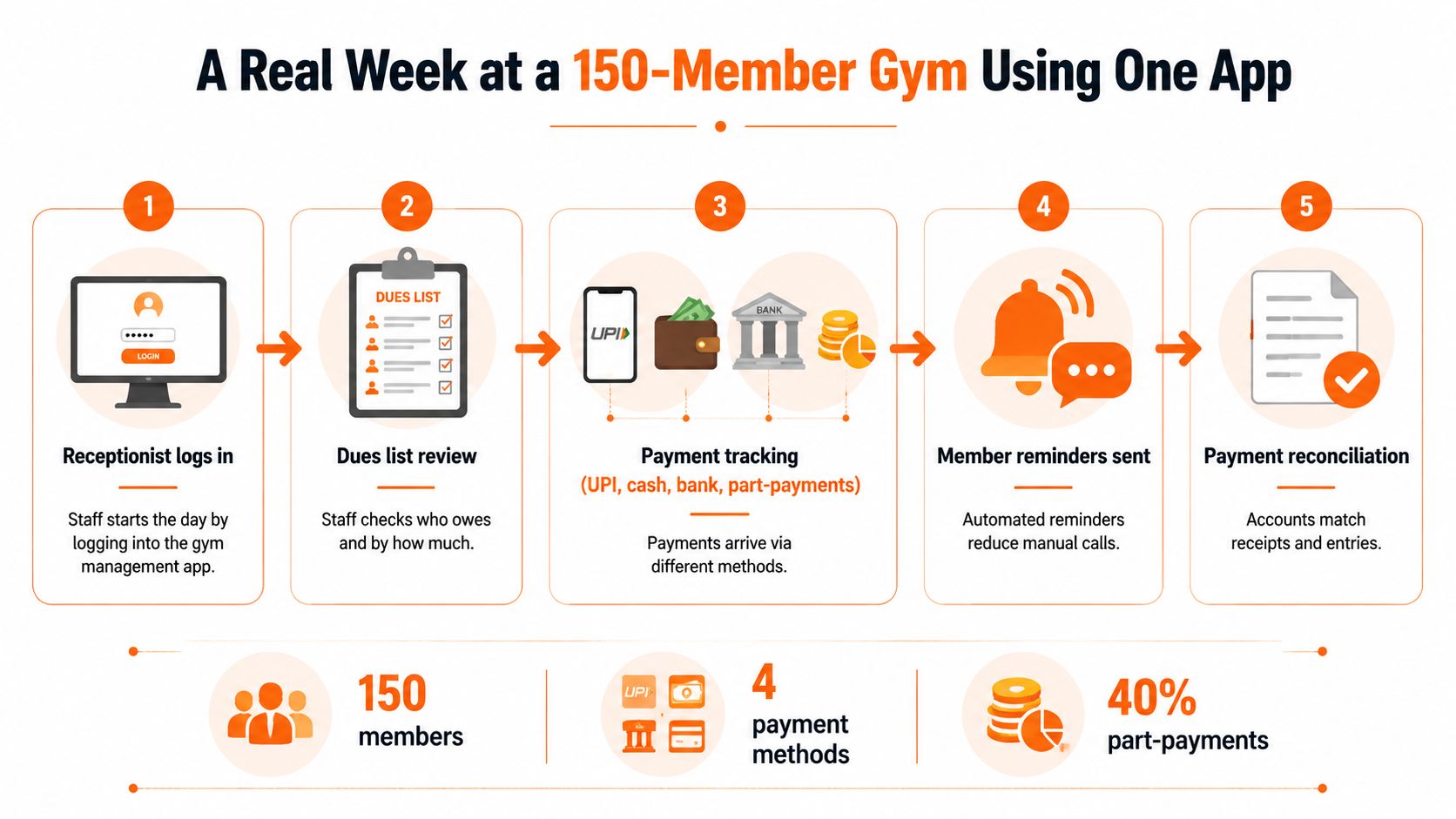
On Wednesday, the owner reviews collections, outstanding fees, and member activity without requesting a fresh spreadsheet. A new joiner receives a membership record, plan details, start date, and receipt in one workflow. If another member is travelling or recovering from illness, staff record a freeze or extension so the expiry date remains accurate.
The week becomes visible
Thursday's work focuses on members who haven't responded. The owner can see which reminders led to payments and which accounts still need a call. That distinction matters because a reminder sent isn't the same as a renewal collected.
By Friday, reconciliation shows the cash received, UPI collected, bank transfers entered, pending balances, and expected renewals. Product sales can be recorded alongside membership income, while staff roles keep routine front-desk access separate from owner-level financial visibility.
The value lies in reducing duplicate entry. The receptionist doesn't need to maintain one record for the member, another for the receipt, and a third for the dues list. The owner doesn't need to reconstruct the week from messages and bank notifications.
The useful app is the one that remains manageable when the receptionist is busy, not the one with the longest feature list.
The process should also work for a smaller gym with fewer staff. A system that requires an administrator to maintain daily records will fail as soon as the owner is away or the front desk gets crowded. The test is simple. Can staff identify the next action, record the payment, and leave a clean audit trail before serving the next member?
Why WhatsApp Beats a Branded App in India
A branded consumer app asks members to install software, register, remember another password, and return regularly. A gym usually needs one urgent behaviour, the member must renew on time. Those are very different adoption challenges.
WhatsApp works better for reminders because the member already uses it for everyday communication. India has a very large WhatsApp audience, and India-focused business messaging guides describe the platform as reaching more than 90% of Indian smartphone users (WhatsApp and RCS business messaging in India). The gym can send the due date, payment instructions, confirmation, and receipt without asking the member to learn another interface.
Match the channel to the job
WhatsApp isn't automatically better for workout tracking, class discovery, or a premium community experience. A branded app may make sense for a large chain offering workout programmes, class reservations, personal training, or member challenges. Those capabilities must justify the installation and ongoing use.
For a neighbourhood gym, the stronger combination is structured records inside the gym membership app and lightweight communication through WhatsApp. Staff can keep plan dates and payment history in the system while members receive messages in the channel they already recognise.
The payment flow still needs discipline. A UPI QR code or payment prompt helps the member begin the transaction, but staff must verify and record the payment. A simple resource on QR codes for WhatsApp chat can help a gym create a direct conversation entry point for enquiries and support.
Automation should follow the renewal calendar
A useful sequence sends a reminder before expiry, another around the due date, and a follow-up after lapse. The message should identify the member, show the relevant plan or due amount, and give clear payment instructions. It shouldn't become a noisy broadcast that staff can't monitor.
The owner should check whether the software records message activity and member responses. If staff still need to remember whom they contacted, automation hasn't solved the process.
The automated WhatsApp messages guide offers practical context for setting up this kind of workflow. The principle remains straightforward. Use the gym system for truth, and use WhatsApp for action.
How GymPilot Fits the Buying Criteria
GymPilot fits the India-focused criteria when the gym needs member records, mixed payment tracking, WhatsApp communication, attendance, and owner visibility in one web-based system. It provides member management with plan details, start and end dates, expiry status, and payment history. Check-in can be handled through attendance tools, including biometric check-in where the gym uses that setup.
Payment entries can cover UPI, cash, and card, with receipts and searchable logs. Staff can record a payment manually and reconcile it against the member's account. That matters for gyms where money doesn't arrive through one automatic billing route.
Capability mapping
| Buying Criterion | GymPilot Capability |
|---|
| Member records | Member directory with plans, dates, expiry status, and payment history |
| Renewal workflow | WhatsApp welcome messages, receipts, and expiry reminders |
| Payment reality | UPI, cash, card, dues, and payment records |
| Owner oversight | Revenue dashboard and collection visibility |
| Staff control | Staff management with roles and restricted access |
| Attendance | Attendance and check-in, including biometric check-in |
| Business visibility | Revenue dashboard and product sales tracking |
| Communication backup | Email notifications alongside WhatsApp |
| Accountability | Activity logs with timestamps for staff actions |
GymPilot's WhatsApp automation covers welcome messages, payment receipts, and expiry reminders. Owner alerts can surface additions, renewals, and payments, while staff roles separate front-desk work from sensitive settings. The system also includes product sales, which helps a gym keep merchandise, drinks, or supplement transactions in the same operational view.
Where it fits, and where it doesn't
GymPilot is designed for independent gyms, fitness studios, and smaller chains that want a straightforward operating system. It isn't positioned as a replacement for a large branded consumer app with extensive community, booking, or fitness-content functions. That is a deliberate boundary, not a missing promise.
A gym owner should still run the same live workflow test used for any vendor. Staff should enter members, record cash and UPI, process a part-payment, check expiry status, send a reminder, and inspect the revenue dashboard. Pricing details are available on GymPilot's pricing page.
Your Next Step as a Gym Owner
The buying decision should start with the gym's current failures, not with a vendor's feature list. The owner and front-desk staff can complete a useful audit in one working day.
- Audit renewals: List memberships that expired recently, payments still marked as pending, and members who received no follow-up.
- Pick three features: Choose the three controls that would fix the largest problems, such as expiry lists, WhatsApp reminders, or mixed payment tracking.
- Shortlist practical tools: Compare two or three systems that support UPI, cash, WhatsApp communication, receipts, and a simple ledger.
- Run the workflow live: Book a short demonstration and ask staff to complete a new joiner, payment, receipt, reminder, and reconciliation flow.
- Measure the pilot: Track renewals, collections, unresolved dues, and staff feedback throughout the test.
The gym doesn't need software that looks impressive in a sales presentation. It needs a reliable record of who owes money, what has been paid, when a plan expires, and which staff member handled the transaction.
A sensible pilot should use real operational scenarios. Staff should test UPI, cash, card, and part-payments, then verify that the member balance, receipt, expiry status, and owner dashboard all agree. The owner should also check whether the system remains usable during a busy reception shift.
The best gym membership app for an Indian gym is the one that makes renewals visible and collections clean. Owners should audit this week's leakage, shortlist tools built around local payment behaviour, and book a live workflow demonstration before committing.
Gym owners can start today by writing down every overdue renewal and unreconciled payment, then testing whether a shortlisted gym membership app resolves those records without a spreadsheet. Book a live demonstration, run the front-desk workflow with actual staff, and choose the system that delivers fewer missed renewals and clearer cash tracking, not just a flashier member app.
 GymPilot Team